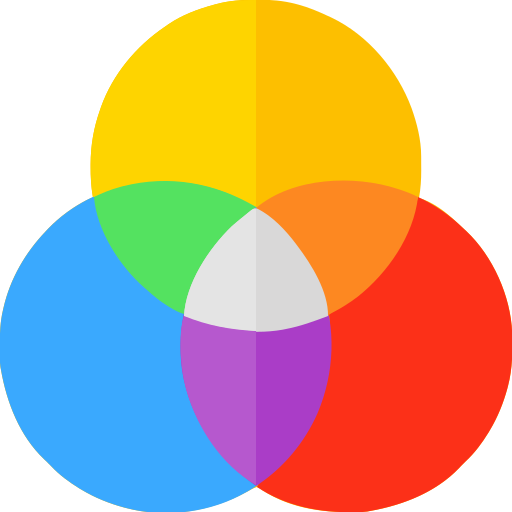
What Colors Make Purple? Mixing Guide & Shade Chart
The short answer: purple is made by mixing red and blue. For a vibrant purple use a warm red (alizarin crimson) plus a warm blue (ultramarine). For a softer or muted purple, add a touch of white or burnt umber.
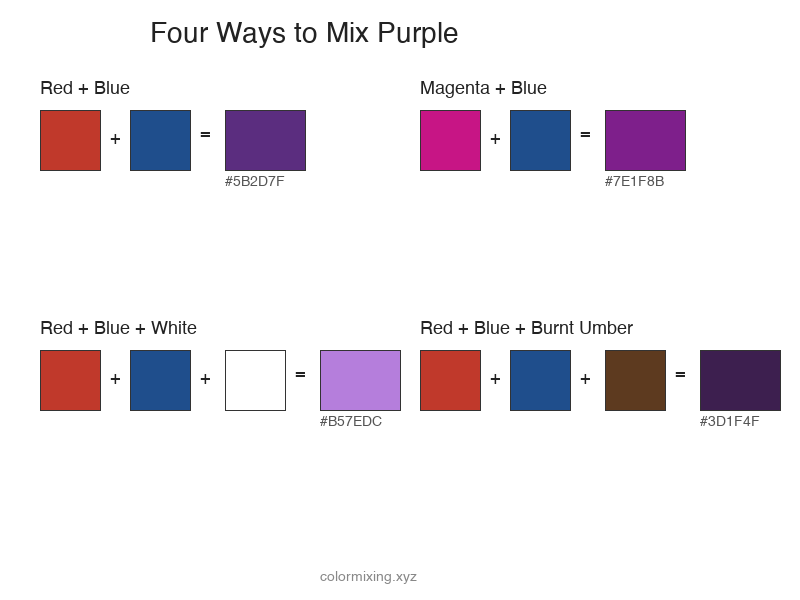
The Three Simplest Purple Mixing Recipes
Purple sits between red and blue on the color wheel, which means every purple recipe starts with those two primaries. The skill is choosing the right red and the right blue so that yellow undertones — the enemy of purple — never sneak into the mix. The three recipes below cover almost every situation an artist, designer, or baker will face, whether you need a saturated royal purple, a soft lavender, or a deep aubergine for a shadow pass.
1. Red + Blue = Purple
The classic recipe. Combine alizarin crimson with ultramarine blue in roughly equal parts and you land on a clean, deep violet that artists have used for centuries. Start with the red on your palette and add blue one brushstroke at a time. More red shifts the mix toward warm wine; more blue pulls it into cool indigo. Stop the moment the color reads unambiguously purple.
2. Magenta + Cyan = Vibrant Purple
For the brightest possible purple, skip traditional red and blue and reach for the printer's primaries: magenta and cyan. Magenta already carries the red-violet bias purple needs, and cyan or ultramarine adds the blue depth without dragging in any green undertone. This pairing produces a chromatic, almost neon purple favored in digital art, screen printing, and CMYK-based design work where saturation matters more than naturalism.
3. Red + Blue + White = Lavender
To create lavender or any pastel purple, mix your base purple first, then introduce white last. Adding white too early dilutes the chroma before the hue has set, and you end up with a chalky grey-violet. Whip up alizarin and ultramarine into a saturated purple, then fold in titanium white a little at a time until the lavender reaches the softness you want — like fresh lilacs in afternoon light.
Try It: Interactive Purple Mixer
Below is our color mixer pre-loaded with a classic purple (#800080). Drag the sliders, adjust the primary inputs, and watch how purple emerges from combinations of red and blue. You can also enter your own target hex and the mixer will suggest a recipe.
How to Mix Different Shades of Purple
Once you have a base purple, almost every named purple shade can be reached by tweaking the ratio of red to blue or adding a small amount of white, grey, or earth tone. The table below lists the most common variations along with their approximate hex values so you can match them in both paint and digital workflows.
| Shade | Recipe | HEX |
|---|---|---|
| Lavender | Purple + lots of white | #B57EDC |
| Lilac | Purple + white + hint of magenta | #C8A2C8 |
| Royal purple | Alizarin + ultramarine | #4B0082 |
| Plum | Purple + burnt umber | #6B3FA0 |
| Eggplant | Purple + raw umber + alizarin | #563C5C |
| Mauve | Purple + grey + white | #B784A7 |
| Magenta-purple | Magenta + ultramarine | #8B008B |
| Wine | Alizarin + small amount of ultramarine | #722F37 |
Mixing Purple in Different Mediums
The same color theory underlies every medium, but the physical behavior of paint, ink, or dye changes how you should approach the mix. Below are practical notes for five of the most common situations where you might need to make purple from scratch.
Acrylic Paint
Acrylic offers the quickest path to purple because dioxazine purple is sold as a single-pigment tube and mixes cleanly with white, red, or blue without losing chroma. If you prefer to mix from scratch, combine alizarin crimson with ultramarine blue — they neutralize less than other pairings. Because acrylic dries fast and shifts slightly darker as it cures, work on a wet palette or add a few drops of retarder so you have time to push the hue toward warm or cool before it sets.
Oil Paint
Oils give you the longest working time and the richest purple mixes. Ultramarine blue and permanent rose (or quinacridone magenta) build a luminous, gem-like purple that holds up beautifully in glazes. Because oils dry slowly, you can nudge the warmth or coolness of the mix on the canvas for hours — scumble more red into the shadow side, or pull a cooler ultramarine note into the lights. Avoid mixing more than three pigments at once to keep the chroma alive.
Watercolor
Watercolor purple thrives on transparency. Quinacridone magenta combined with ultramarine blue produces a vibrant, granulating purple ideal for florals, distant hills, and shadow washes. Mix on the paper using a wet-on-wet technique rather than blending on the palette — the pigments will bloom and settle into soft lavenders and deeper violets in the same stroke. Test every purple on a swatch first; watercolors dry around 30% lighter than they appear wet, so build value in transparent layers.
Food Coloring (Baking & Icing)
For buttercream, fondant, or royal icing, use gel food coloring rather than liquid — liquid dye thins the icing and turns the color grey instead of vivid purple. Mix red gel and blue gel in roughly a 2:1 ratio (slightly more red than blue) and stir with a toothpick until the streaks disappear. For a warmer berry purple, add a tiny dab of pink. Let the colored icing rest for 30 minutes; food coloring deepens significantly as it sits.
Hair Dye
Purple hair shades are achieved with direct dyes — semi-permanent violet pigments that sit on the hair shaft rather than penetrating it like permanent color. For vibrant purple, pre-lighten the hair to a pale yellow level 9 or 10 first; on darker bases, the violet pigment will read brown or barely show. Purple fades to pink or silver depending on the pigment ratio, so refresh every three to four washes. Strand-test before applying to the full head.
Common Mistakes When Mixing Purple
- Using a cool red (cadmium red). Cadmium red leans orange because it carries yellow undertones, and yellow is purple's complement — it cancels the mix straight into brown. Reach for alizarin crimson, quinacridone magenta, or permanent rose instead.
- Using a cool blue (cerulean) without warming it. Cerulean and phthalo blue both carry green undertones that mute purple into a dusty blue-grey. If you must use them, balance with a warmer blue like ultramarine, or accept that the result will be a muted violet rather than a vivid one.
- Adding too much white at once. White instantly washes out chroma. Mix your saturated purple first, then introduce white in pinhead-sized dabs. The moment lavender appears, stop — one more brush of white and you'll be at chalky off-white.
- Mixing wet. Excess water (or medium) over-thins the pigment and produces a washed-out, muddy purple. Mix at full strength on a dry palette first, then thin only the application stroke as needed.
- Trying to "darken" purple with black. Black kills the warmth and chroma of purple and pushes it toward neutral grey. To deepen purple, reach for burnt umber, Payne's grey, or a darker red like alizarin crimson — they lower value while keeping the hue alive.
Purple Color Theory in Two Sentences
Purple is what happens when red and blue overlap on the color wheel — a "tertiary mix" of two cool primaries that sits between them on the spectrum. Because there is no green primary involved in a clean purple recipe, the more saturated and bias-correct your red and blue are, the more vivid the resulting purple; any yellow that sneaks in via cadmium red or a warm blue immediately drags the mix toward brown or grey, which is why pigment selection matters more for purple than for almost any other secondary color. Master this single principle and you can mix any purple — royal, lilac, plum, aubergine — using only two tubes of paint plus white.
FAQ
What two colors make purple?
Red and blue. Use a slightly warm red (alizarin crimson) and a warm blue (ultramarine) for a true violet.
What three colors make purple?
Red, blue, and a touch of white or magenta. The third color only adjusts brightness or warmth — pure purple needs only red and blue.
How do you make dark purple?
Add a small amount of burnt umber, payne's grey, or a darker red like alizarin crimson. Avoid pure black, which turns purple muddy.
How do you make light purple (lavender)?
Add white to base purple. For a cooler lavender, mix in a hint of cerulean blue along with the white.
Why does my purple look brown or grey?
You're using a cool red (cadmium red) with a cool blue. Cool red contains yellow, and yellow neutralizes purple into brown or grey. Use alizarin crimson or magenta instead.
What's the difference between purple and violet?
They're often used interchangeably. Technically, violet sits closer to blue on the color wheel and purple closer to red, but in paint mixing the recipes are the same.