What Colors Make Brown? Complete Mixing Guide With Chart
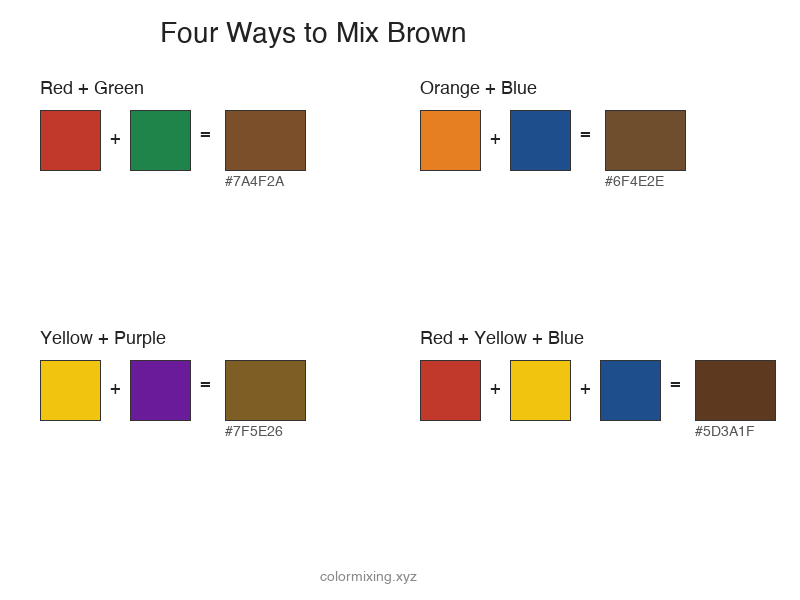
The short answer: brown is made by mixing complementary colors — red + green, orange + blue, or yellow + purple. You can also mix all three primary colors (red, yellow, blue) in roughly equal parts.
The Three Simplest Brown Mixing Recipes
Every shade of brown you see on canvas, in furniture, or in nature can be traced back to one principle: brown is a desaturated warm color. There are three reliable combinations any artist can use to produce a clean, controllable brown without ever reaching for a tube of black or a pre-mixed brown paint.
1. Red + Green = Brown
Red and green sit directly opposite each other on the color wheel, so they cancel one another out into a neutral. The exact result depends on which red and green you choose. Cadmium red with sap green produces a warm, almost rust-toned brown that looks beautiful in autumn landscapes. Alizarin crimson combined with phthalo green leans cooler and darker — closer to a deep chocolate. Adjust the ratio: more red gives a warmer brown, more green produces an olive-leaning brown.
2. Orange + Blue = Brown
This is the most forgiving recipe and the one most painting instructors teach first. Start with orange — either a tube color or a mix of red and yellow — and add blue a little at a time. Ultramarine blue gives a warm, slightly violet brown ideal for skin tones and wood. Cerulean blue produces a softer, slightly greyer brown well-suited to skies, stones, and atmospheric backgrounds. Stop adding blue before the mix turns grey; brown lives just before that tipping point.
3. Yellow + Purple = Brown
Yellow and purple are also complementary, so they neutralize into brown. Use yellow ochre with dioxazine purple for a rich, earthy brown that mimics raw umber straight from the tube. Cadmium yellow paired with a mixed violet creates a brighter, more golden brown. This combination is especially useful when you want a brown with a slight warm glow — perfect for sunlit foliage, hair highlights, or weathered wood. Add white sparingly to lift the mixture without losing its warmth.
Try It: Interactive Brown Mixer
Below is our color mixer pre-loaded with a classic saddle brown (#8B4513). Drag the sliders, adjust the primary inputs, and watch how brown emerges from combinations of red, yellow, and blue. You can also enter your own target hex and the mixer will suggest a recipe.
How to Mix Different Shades of Brown
Once you have a base brown, almost every named brown shade can be reached by tweaking the ratio of one component or adding a small amount of white, blue, or red. The table below lists the most common variations along with their approximate hex values so you can match them in both paint and digital workflows.
| Shade | Recipe | HEX |
|---|---|---|
| Light brown / tan | Brown + white + touch of yellow | #C19A6B |
| Dark brown | Brown + small amount of blue | #3E2723 |
| Warm brown | Brown + cadmium red | #8B4513 |
| Cool brown | Brown + ultramarine | #5D4037 |
| Chocolate | Burnt sienna + ultramarine | #3E1F0E |
| Beige | Brown + lots of white | #E8DCC4 |
| Russet | Burnt sienna + alizarin crimson | #80461B |
| Walnut | Burnt umber + a hint of ultramarine | #5C4033 |
Mixing Brown in Different Mediums
The same color theory underlies every medium, but the physical behavior of paint, ink, or dye changes how you should approach the mix. Below are practical notes for five of the most common situations where you might need to make brown from scratch.
Acrylic Paint
Acrylics dry quickly and shift slightly darker as they cure, so mix a touch lighter than your target. The cleanest brown in acrylic comes from burnt sienna plus ultramarine blue — together they create a deep, chromatic black-brown that artists call "Rembrandt brown." If you need a brown that stays workable longer, add a slow-dry medium or a few drops of retarder. Avoid mixing more than three pigments at once; acrylic loses chroma fast when you over-blend, ending up as flat mud.
Oil Paint
Oils give you the longest working time and the richest brown mixes. Burnt umber and raw umber are the classic landscape browns and serve as excellent bases; warm either with a touch of cadmium red, or cool with a brush of ultramarine. For figurative work, mix burnt sienna, yellow ochre, and a hint of viridian to build flesh-tone shadows. Because oils dry slowly, you can adjust the brown on the canvas for hours — wipe off, add a complement, or scumble lighter brown over the wet layer.
Watercolor
Watercolor brown depends almost entirely on how much water you use. Sepia mixed with Payne's grey gives a stormy, atmospheric brown ideal for shadows under trees and distant hills. For a luminous wash, mix burnt sienna and ultramarine on the paper rather than the palette using a wet-on-wet technique — the granulation creates beautiful texture. Test every brown on a swatch before applying; watercolors dry roughly 30% lighter than they appear wet, so build value in transparent layers rather than a single dense pass.
Food Coloring (Baking & Icing)
For buttercream, fondant, or royal icing, use gel food coloring instead of liquid — liquid dye thins the icing and weakens the color. The reliable ratio is 4 parts red, 2 parts yellow, and 1 part blue (or 4:2:1 red:yellow:blue gel). Mix in tiny dabs with a toothpick, stir thoroughly, and let the icing rest for 30 minutes; food coloring deepens significantly over time. For chocolate brown, start with that ratio and add a touch more red and a pinch of cocoa powder for depth.
Hair Dye
Hair dye chemistry combines red, orange, and yellow underlying pigments with ash (blue-green) neutralizers to land on the right brown. A warm chestnut brown uses red-orange undertones with a small ash modifier. A cool ash brown relies on blue-violet correctors that cancel the natural warmth in lifted hair. Going darker without going muddy means adding violet-based pigments rather than pure black, which can read greenish on faded hair. Always strand-test before applying to the full head — natural starting tone changes every result.
Common Mistakes When Mixing Brown
- Adding too much blue. Blue is the strongest pigment in any brown recipe. Two drops more than needed and your warm brown collapses into cool grey. Always add blue in tiny increments and stir thoroughly between additions.
- Mixing with too much water (or medium). Diluting brown over-thins the pigment and produces a muddy, washed-out result. Mix at full strength first, then thin the final color only as needed for the application.
- Using black to darken brown. Black kills the warmth that makes brown feel like brown. Reach for ultramarine blue or burnt umber to deepen the value while keeping the chroma alive.
- Not starting with a warm base. Cold reds (like alizarin crimson) plus cold blues (like phthalo) can shift the mix toward grey instead of brown. Begin with at least one warm pigment — cadmium red, yellow ochre, or burnt sienna.
- Mixing all primaries at once. Dumping red, yellow, and blue together in one go almost always produces mud. Build orange first by combining red and yellow, then add blue gradually until you land on the brown you want.
Brown Color Theory in Two Sentences
Brown is not a separate color on the wheel — it is a low-saturation orange or red-orange sitting between red and yellow, darkened by its complement. That is why every brown recipe contains at least one warm tone (red, orange, or yellow); the cool complement merely lowers the saturation without removing the warmth, leaving the eye to read the result as brown rather than grey. Understanding this single principle lets you mix any brown you can imagine using only the pigments already on your palette, without ever buying a dedicated brown tube or relying on pre-mixed colors that limit your range.
FAQ
What two colors make brown?
Mix any complementary pair: orange and blue, red and green, or yellow and purple. Each pair combines into a brown.
What three colors make brown?
The three primary colors — red, yellow, and blue — in roughly equal parts. Mix red and yellow to get orange, then add blue a little at a time.
How do you make dark brown?
Add more blue (ultramarine) to base brown for a cool dark brown, or add a touch of burnt umber for warm dark brown. Avoid black, which deadens the color.
How do you make light brown?
Add white to brown for tan or beige. For a warmer light brown, add yellow ochre instead of white.
What colors make brown without black?
Red plus green, orange plus blue, or yellow plus purple. Black is never required to mix brown.
What is the easiest way to mix brown?
Start with orange (or red plus yellow), then add a small amount of blue until you reach the brown you want.