
What Colors Make Green? Mixing Guide & Shade Chart
The short answer: green is made by mixing blue and yellow. For a vivid result use a cool blue (phthalo blue) plus a warm yellow (cadmium yellow). For a muted, natural shade, add a hint of burnt sienna or its complement, red.
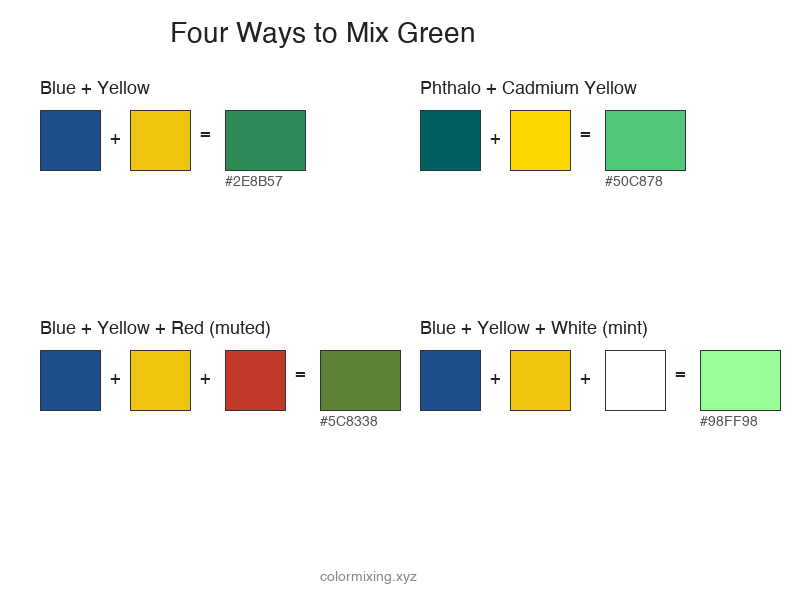
The Three Simplest Green Mixing Recipes
It is the easiest secondary color to mix because it sits between two primaries that almost every palette already includes. The trick is choosing the right blue and the right yellow — the bias of each pigment controls whether the mix turns out vivid, natural, or muddy. Below are three reliable recipes that cover every situation, from spring foliage to digital lime.
1. Blue + Yellow = Green
This is the classic recipe taught in every art class. Use phthalo blue with cadmium yellow for a clean, balanced result that leans neither too warm nor too cool. Phthalo is a cool blue with a slight green bias, and cadmium yellow is a warm yellow — together they produce a saturated, leaf-like hue. Adjust the ratio: more yellow gives a brighter, springier tone, more blue moves toward forest or teal.
2. Cyan + Yellow = Bright Green
For digital work, lime tones, or anything that needs to glow, swap phthalo for cyan or cerulean blue. Cyan is closer to pure spectral blue-green, so when combined with cadmium yellow it pushes the mix toward an electric chartreuse. This is the recipe behind highlighter shades, traffic-sign brights, and most digital UI tones. Use sparingly in fine art — the result can read as artificial against natural surroundings.
3. Blue + Yellow + Red = Muted Green
Pure greens look unnatural in landscape painting. Adding a tiny amount of red — green's complement — desaturates the mix into the olives, sages, and forest tones you actually see in nature. Start with your base mix, then introduce red one brush-tip at a time. Cadmium red produces warm olive; alizarin crimson cools it into a sage. This is how master painters avoid the dreaded "fluorescent lawn" look.
Try It: Interactive Green Mixer
Below is our color mixer pre-loaded with a classic forest green (#228B22). Drag the sliders, adjust the primary inputs, and watch the hue emerge from combinations of blue and yellow. You can also enter your own target hex and the mixer will suggest a recipe.
How to Mix Different Shades of Green
Once you have a base green, almost every named green shade can be reached by tweaking the ratio of one component or adding white, a touch of red, or a different blue. The table below lists the most common variations along with their approximate hex values so you can match them in both paint and digital workflows.
| Shade | Recipe | HEX |
|---|---|---|
| Mint | Green + lots of white | #98FF98 |
| Lime | Cadmium yellow + phthalo blue (more yellow) | #BFFF00 |
| Sap green | Phthalo green + raw sienna | #5C8338 |
| Forest green | Phthalo green + burnt sienna | #228B22 |
| Olive | Yellow ochre + ultramarine | #708238 |
| Sage | Green + grey + white | #B2AC88 |
| Emerald | Phthalo green + cadmium yellow | #50C878 |
| Teal | Phthalo green + ultramarine | #008B8B |
Mixing Green in Different Mediums
The same color theory underlies every medium, but the physical behavior of paint, ink, or dye changes how you should approach the mix. Below are practical notes for five of the most common situations where you might need to make green from scratch.
Acrylic Paint
Acrylics dry quickly and shift slightly darker, so test your mix on a swatch before committing to a large area. Phthalo green is the most economical base — a tiny amount stretches a long way. For landscape work, mix phthalo blue with cadmium yellow rather than reaching for a ready-made tube; the hand-mixed version has more chromatic life. Add a drop of retarder if you need to blend foliage edges wet-into-wet, since acrylic skin forms within minutes and can leave streaks across large leafy passages.
Oil Paint
Oils give you the longest open time for green mixing, which matters because subtle green shifts read clearly to the eye. Cobalt blue with lemon yellow produces a bright, transparent spring green ideal for new foliage. Viridian is the traditional ready-made green and stays useful for glazing over earth tones. Because oils dry over days, you can nudge the warmth of a green for hours — wipe a passage back, scumble warmer yellow over a cool base, or glaze a thin red over the top to mute saturation without losing depth.
Watercolor
Watercolor green depends on transparency and water control. Phthalo blue plus new gamboge is the classic landscape green and granulates beautifully on cotton paper. For foliage masses, apply wet-on-wet — drop yellow onto a damp blue wash and let the pigments mingle on the paper rather than the palette. Lift highlights with a damp brush before the wash dries to suggest sunlight on leaves. Test every wash on a swatch first; watercolor dries roughly 30% lighter than it looks wet.
Food Coloring (Baking & Icing)
For buttercream, fondant, or royal icing, use gel food coloring instead of liquid — liquid dye thins the icing and weakens the color. The reliable ratio is 1 part blue gel to 3 parts yellow gel for a clean grass green. Add fewer drops than you think you need; over-tinting pulls icing toward grey. For a natural alternative, matcha powder gives a soft sage-green tint plus a subtle flavor. Let icing rest for 30 minutes before judging the final tone — food coloring deepens significantly as it sits.
Hair Dye
Green hair shades require a pre-lightened blonde base — direct dye sits on the cuticle and needs a pale canvas to read true. Manic Panic Venus Envy, Arctic Fox Phantom Green, and Pulp Riot Lime are popular direct dyes that deposit vivid green without developer. Be aware that blue toners applied to yellow-toned hair can shift the result toward green unintentionally, especially if the underlying pigment is brassy. Always strand-test before committing to a full application, and use a colour-safe shampoo to preserve the shade.
Common Mistakes When Mixing Green
- Using ultramarine (warm blue) with lemon yellow (cool yellow). Both pigments lean toward red, and red neutralizes green. The mix collapses into olive or muddy grey instead of producing a clean green. Pair a cool blue with a warm yellow instead.
- Mixing too much water in watercolor. Over-thinning a green wash drops chroma fast — the result reads grey-green rather than vibrant. Mix at full strength on the palette, then dilute only on the paper as needed.
- Trying to "darken" green with black. Adding black to green turns the mix muddy and lifeless. Use a small amount of red, burnt sienna, or alizarin crimson to deepen value while keeping the green alive.
- Forgetting that some "yellows" are actually orange. Cadmium yellow deep and other orange-shifted yellows contain red, which shifts your mix toward olive instead of green. Check the pigment label; PY35 (cadmium yellow) and PY3 (hansa lemon) behave very differently.
- Buying green tubes instead of mixing. Store-bought greens are often too cool (phthalo) or too vivid (permanent green light) for natural scenes. Mixing from scratch gives you control over warmth, value, and chroma — the three variables that make foliage look real.
Green Color Theory in Two Sentences
Green is what happens when blue (a cool primary) and yellow (a warm primary) overlap on the color wheel — the closer to equal parts, the more "true" the hue, while leaning blue gives teal and leaning yellow gives lime. Red is the complement, which is why a tiny dab of it mutes the mix naturally without killing its warmth, and why painters reach for earth reds like burnt sienna instead of black whenever they want a deeper, more believable foliage tone.
FAQ
What two colors make green?
Blue and yellow. Use a cool blue (phthalo or cerulean) with a warm yellow (cadmium yellow) for the cleanest green.
What three colors make green?
Blue, yellow, and a touch of white or black. White lightens, a hint of black or burnt sienna deepens — but pure green needs only blue and yellow.
How do you make dark green?
Add a small amount of burnt sienna, alizarin crimson, or payne's grey to base green. Avoid pure black, which turns green grey.
How do you make light green (mint)?
Add white to base green for mint or seafoam. For a fresher tone, add a tiny bit of cadmium yellow with the white.
Why does my green look dull or muddy?
You're using a warm blue (ultramarine) with a cool yellow (lemon). Both contain red, and red neutralizes green into olive or grey. Use phthalo blue plus cadmium yellow instead.
What's the difference between phthalo green and sap green?
Phthalo green is a vivid synthetic pigment, very saturated and cool. Sap green is a warmer, more muted historic landscape green — usually a blend of phthalo with iron oxides.